
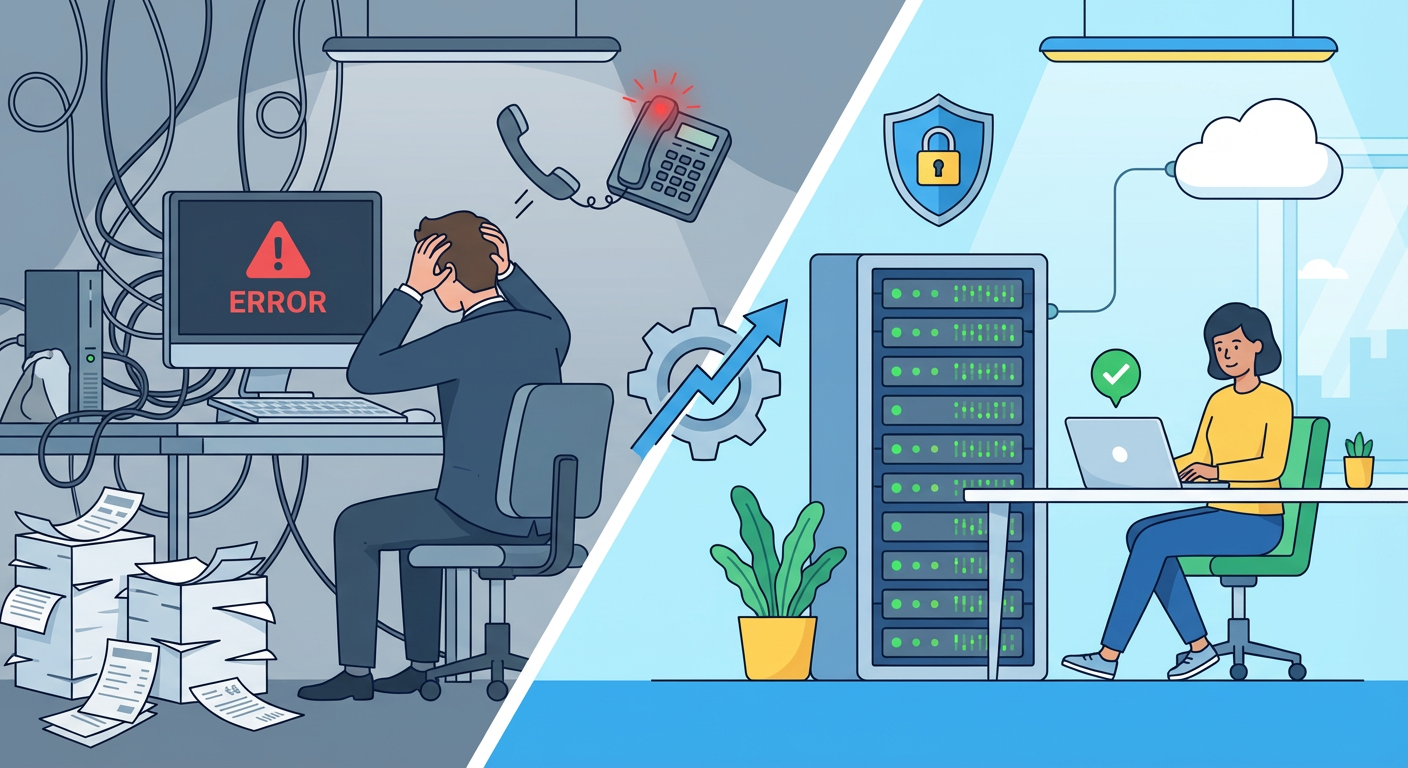
If your IT support strategy is “call someone when something breaks,” you’re not alone, but you may be more exposed than you realize. Recent data shows that 94% of small and midsized businesses faced at least one cyberattack last year, and 55% of ransomware incidents targeted companies with fewer than 100 employees. The old model of paying a technician to show up after something fails worked fine when your business was smaller and simpler. But if your company has grown to 30, 40, or 50 employees—and you’re relying on technology to run nearly every part of your operation—that reactive approach may be costing you more than you think.
Here are five signs you’ve outgrown break-fix IT, and what a smarter support model actually looks like.
What “Break-Fix” Means (And Why It Worked—Until Now)
Break-fix IT is exactly what it sounds like: something breaks, you call someone to fix it, and you pay by the hour or by the incident. There’s no ongoing relationship, no monitoring between calls, and no one keeping an eye on your systems when everything seems fine. For a long time, this model made sense. If you had a handful of employees, a few computers, and minimal reliance on technology, paying only when something went wrong felt efficient.
But most businesses have crossed a threshold without realizing it. You’ve added employees, devices, and cloud applications. Your team can’t function without email, your CRM, or your internet connection. When something goes down now, it doesn’t just inconvenience one person; it stalls your whole operation. That’s when the break-fix model starts breaking down.
The 5 Signs You’ve Outgrown Break-Fix IT
1. The Same Problems Keep Coming Back
If your team has started saying things like “that computer always does this” or “the network gets slow every afternoon,” that’s a red flag. Recurring problems mean someone is treating symptoms, not root causes.
Break-fix providers are paid to resolve the issue in front of them, not to investigate why it keeps happening. We’ve seen companies call about the same server issue three times in six months—each time paying for an emergency visit—before discovering a failing hard drive that proactive monitoring would have flagged months earlier.
When you’re paying by the incident, there’s no incentive for anyone to solve the underlying problem permanently.
2. You’re Spending More Time on IT Fires Than Running Your Business
When leadership is troubleshooting printer issues, or your office manager has become the unofficial “IT person,” something’s off. That time has a cost—even if it never shows up on an invoice.
The real expense isn’t the repair bill. It’s the opportunity cost of what you’re not doing while you’re on hold with tech support or rebooting the server for the third time this week. If the people you’re paying to run your business are instead chasing down technology problems, your IT support isn’t supporting much of anything.
3. You’re Worried About Security But Don’t Have a Clear Plan
Here’s the stat that should get your attention: 94% of small and midsized businesses experienced at least one cyberattack in 2024. And despite what many business owners assume, small companies aren’t too small to be targets—55% of ransomware attacks hit businesses with fewer than 100 employees, and 75% targeted companies with less than $50 million in revenue.
Break-fix providers typically don’t offer the ongoing services that actually protect you: threat monitoring, regular patching, endpoint protection, verified backups, or employee security awareness training. They show up after something goes wrong.
Ask yourself: if your business got hit with ransomware tomorrow, do you know what would happen? Do you know how long you’d be down? Do you have backups that have actually been tested? If you can’t answer those questions confidently, you have a gap—and break-fix IT isn’t going to close it.
4. Your IT Costs Are Unpredictable
One of the supposed advantages of break-fix is that you only pay when something goes wrong. But that also means you have no idea what next month’s IT bill will look like. It could be $300. It could be $3,000. And emergencies always seem to hit at the worst possible time—during your busiest season, right before a deadline, or at 4:45 on a Friday.
Emergency rates often run two to three times higher than standard hourly fees. When you’re in crisis mode, you don’t have leverage to negotiate—you just need the problem fixed. That unpredictability makes budgeting nearly impossible and turns IT from a manageable expense into a source of stress.
5. Nobody’s Helping You Plan Ahead
Break-fix IT is purely reactive. No one is advising you on when to replace aging equipment before it fails. No one is helping you think through how to scale your systems as you add employees. No one is keeping track of compliance requirements that might affect your industry or flagging risks before they become problems.
Technology should be a tool that supports your business goals—not just something that “isn’t broken at the moment.” If the only time you hear from your IT support is when you call them with a problem, you don’t have a technology partner. You have an expensive emergency contact.
What Managed IT Services Actually Includes
Managed IT services flip the break-fix model on its head. Instead of waiting for things to fail, a managed service provider (MSP) monitors your systems continuously, maintains them proactively, and helps you plan for what’s ahead—all for a predictable monthly fee. [INTERNAL LINK: Managed IT Services page]
Here’s what that typically looks like in practice:
24/7 monitoring and alerting catches problems before your team notices them—often before they cause any downtime at all.
Automated patching and updates ensure your systems aren’t sitting with known vulnerabilities that attackers can exploit.
Managed security includes threat detection, endpoint protection, and regular backup verification, not just antivirus software installed and forgotten.
Help desk support with defined response times means you know what to expect when you call, and you’re not waiting days for a callback.
Strategic technology planning gives you a partner who helps you make smart decisions about upgrades, growth, and risk—not just someone who reacts when things go sideways.
The incentive structure matters here. A break-fix provider makes money when things break. An MSP makes money when your systems run smoothly. That alignment changes everything about how your IT gets managed.
Choosing the Right Managed IT Partner
Not all MSPs are created equal, and the cheapest option isn’t always the best fit. Here’s what to look for:
Response time and availability. How quickly can they respond when something urgent happens? Can they get to your office if an issue requires hands-on attention, or are they three states away?
Access to real people. Can you talk to leadership when you need to, or are you just a ticket in a queue? You want a partner who knows your business, not a call center that treats you like a number.
Relevant experience. Do they work with businesses like yours? Do they understand your industry, your compliance requirements, and the way your team actually works?
Clear expectations. What’s included in your agreement? What are the response time commitments? What happens if something falls outside the normal scope? A good MSP will be transparent about all of this upfront.
The goal isn’t just finding an IT vendor. It’s finding a partner who understands your business and helps you make better decisions about technology, not just someone who shows up when you call.
What to Do Next
If two or more of these signs sound familiar, it’s worth having a conversation. A good MSP won’t start with a sales pitch—they’ll start with an honest assessment of where you are, what’s working, and what’s putting you at risk.
That conversation should cover your current setup, your biggest frustrations, your security posture, and your business goals. The point isn’t to pressure you into a contract. It’s to give you a clear picture of whether your IT approach is keeping up with your business or holding it back.
Schedule a 15-minute IT assessment call to find out where you stand.